
The 36-hour crossing from Costa Rica’s port town of Puntarenas to Cocos Island had exceptionally calm seas, a beautiful sunset, and occasional pods of bottlenose dolphins riding the bow of the 115-foot SeaHunter, our home for the next ten days and 21 dives.
Some brown boobies accompanied us on part of the trip, flying around our vessel and picking off flying fish startled by the Sea Hunter (using the vessel much as cattle egrets use cows, riding along to catch the insects they stir up). The birds also used the vessel as a safe place to rest, landing on the railing unbothered by our close presence. One turtle, most likely an olive ridley, and a sea snake were spotted at the surface of the open sea.
Arriving at Cocos before sunrise, we awoke to greetings from boobies, white (fairy) terns, and one or both of the frigatebirds of Cocos, resembling miniature Archaeopteryx. The two species are hard to distinguish: the magnificent frigatebird is slightly larger, with a wingspan of 3 to 4 feet, while female great frigatebirds have a distinctive red eye ring. It was apparently mating season, as the males were regularly soaring the skies with their showy red gular sacs inflated.
While the two skiffs — one for the yellow team and one for the blue team, each with nine divers and two divemasters — were lifted off the mother ship by crane, we had an extensive safety briefing before plunging into the sea at Chatham Bay for our check-out dive, a chance to refine our buoyancy and test our equipment.
 We were met with scores of colorful reef fish: blue and gold snappers, bright yellow juvenile hogfish cleaning, and Cortez rainbow wrasse cleaning red Pacific creolefish, known as sandía, or “watermelon” fish, in Spanish. Documenting fish-cleaning activity, a form of symbiosis, was one of our research objectives for the trip (more on that below).
Ever-present and abundant whitetip reef sharks were seen lying on the sand and swimming through the coral heads, and a beautiful marbled ray glided by to greet us.
It’s always great to be back “home” at Cocos Island, my favorite underwater place on the planet.
But I was alarmed by the water temperature — 84°F. The effects of an incipient El Niño were clearly felt in the overheated water and visible in coral bleaching, which I estimated to already be affecting 10–15% of the shallow coral in Chatham Bay.
Temperatures in the range of 82–86°F were felt throughout the trip, from the surface to depths of 100 feet, and coral bleaching was present at every dive site. El Niño was probably also responsible for a general reduced abundance of fish overall — schools seemed smaller, and fewer seabirds were seen diving on schools of small “bait” fish.
Oceanic Cleaning Stations
 Oceanic cleaning stations — sometimes called the “spas (or car washes) of the sea” — are specific locations, often on coral reefs, where small animals remove wounded or dead skin and parasites from larger fish (and sometimes turtles), helping to maintain the health of their clients while getting an easy meal for themselves. This form of symbiosis is called mutualism, where both species benefit, and it’s critical to maintaining healthy marine communities. (When you don’t have hands, sometimes you need a little help from your friends.)
Documenting the various species of cleaner fish and their client fish is one measure of Cocos’s importance to both migratory and resident species — data collected on this trip, and others, will be compared with past and future regional studies at other oceanic island sites like Malpelo and the Galápagos in the Eastern Pacific.
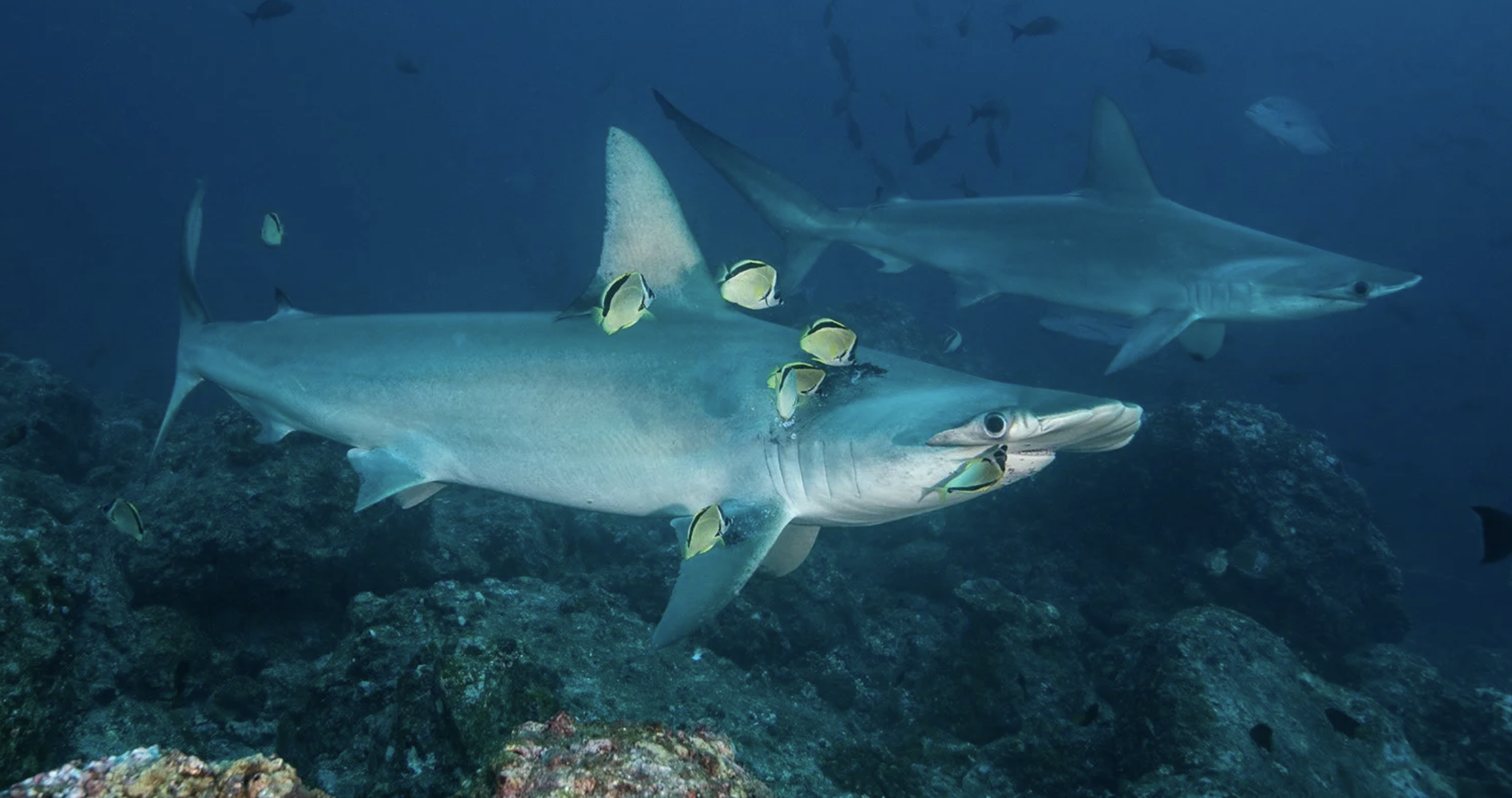
A major draw for divers at Cocos is that several large sharks, especially scalloped hammerheads, use well-established cleaning stations, giving divers the chance to wait nearby for close encounters with a shark that normally keeps its distance from divers and their exhaled bubbles.
I believe these cleaning stations are especially important to female hammerheads following mating, which leaves them with open wounds from males aggressively biting and scraping the pectoral and gill region to align their bodies for copulation (again, fish don’t have hands). In fact, the vast majority of hammerheads at Cocos are females, and the cleaning stations seem most active when the wounds are recent.
 Hammerheads swim into schools of yellow barberfish, and the less abundant king angels, slowing down and turning slightly sideways — probably signaling to the cleaner fish that they aren’t a threat and are ready for their “treatment.”
Hammerhead cleaning stations are found at several Cocos dive sites, with Manuelita Outside, Dirty Rock, and Alcyone being the most active.
This trip was timed to coincide with post-mating activity and the increased hammerhead numbers usually present in June and July, but cleaning activity was low this time. Plenty of hammerheads were seen, but in small schools, usually numbering 5–20 animals. Interestingly, no recent wounds were noted on the females, suggesting the mating season may have shifted this year — possibly due to El Niño. It’s also possible the hammerheads spent more time at depths below where we could dive, seeking cooler water.
Interestingly, the dive site at Little Dos Amigos, a cleaning station for Galápagos and hammerhead sharks, was quite active, with the big sharks being cleaned by yellow barberfish. Oceanic blacktips were also present and being cleaned, but I observed very few hammerheads, and none being cleaned.
The Giant Fish of Cocos Island
The highlight of this trip was seeing three of the five largest fish in the ocean — whale sharks, giant mantas, and tiger sharks — though these riches weren’t evenly distributed between the two skiffs, with the yellow team hitting the jackpot: three whale shark sightings, plus several giant mantas and tiger sharks!
Whale sharks were sighted on different dives: one at Alcyone, and twice at Little Dos Amigos.
These 30-foot behemoths, the largest fish in the sea, make their living filter-feeding on plankton. The whale sharks also provided passage for numerous remoras (suckerfish), which use a modified first dorsal fin — evolved into an oval, sucker-like organ — to hitch rides on sharks, mantas, other fish, turtles, and even whales and dolphins.
The relationship between remoras and their hosts can take various forms of symbiosis. It’s sometimes considered mutualistic, since remoras move around their hosts and feed on skin parasites while hitching a free ride. But it can also be viewed as parasitic: large numbers of remoras, each 1–3 feet long, can create significant drag, forcing even a whale shark to expend more energy to swim.
Another interesting observation, captured on video during this trip, was a Galápagos shark circling a whale shark and seemingly trying to eat the remoras off its body. Is this cleaning behavior a form of commensalism, where only one organism benefits (the Galápagos shark gets an easy meal, with no real benefit to the whale shark), or mutualism (the Galápagos shark gets a meal, and the whale shark benefits from reduced drag)?
Giant mantas are also filter feeders, with wingspans that can reach 22 feet. One encounter with a manta at Punta Maria lasted nearly 20 minutes, the animal moving back and forth and seemingly making eye contact with each diver. Remoras were seen on the giant mantas as well.
Cocos Island’s marine life is so diverse and dynamic, always in flux due to shifting weather and currents that deliver different water temperatures and nutrients. After 30 trips and more than 600 dives, I am always amazed, and never disappointed.
Help Turtle Island protect Cocos Island’s biodiversity and its highly migratory sharks and turtles. Take action to encourage its completion and support the Cocos-Galápagos Swimway Campaign with a donation.
Photo and video credits: Fish photos by Avi Klapfer, Hammerhead photo by Edwar Herreno. Whale shark video by Dr. Jason E. Farley and Mr. David Dial from Middle River, MD, Hammerhead shark and manta videos by Oscar Steiner.


